
To the Editor of The New York Times:
I beg your indulgence to insert a few remarks in the columns of your paper in connection with your editorial article of last Thursday?s Times on "A Macedonian solution."
Those of us, Macedonians, whose families have been scattered to the four winds as a result of the political unrest in the country are quite convinced that the Macedonian question has not been presented to the American public in the light of an untainted justice. Should Macedonia be subjected to another pre-war re'gime, it will be a bitter disappointment to hundreds of us who donned the khaki to defend the honor of the United States and her broad principles which the Allies ultimately adopted. May I not, then, present some gleanings which I have gathered at the feet of my professors here at Harvard, some of whom have gone to Paris to advise the President in these matters?
The fact that nothing has been said publicly at the Peace Conference concerning the future fate of Macedonia is in itself a confession of the almost insurmountable difficulties involved in the so-called "Macedonian Question." It is a question open to no dispute that an amicable solution of the Macedonian problem will be the only stable basis for a lasting peace in the Balkans. But how can the Macedonian question be settled so as to guarantee the future tranquility of the Balkans? Students of Balkan politics have suggested three methods for settling this all-important problem.
The first method is repartition of Macedonia on the basis of the Bulgaro-Serbian treaty of 1912. While it provides the basis for negotiation between Bulgaria and Serbia, yet this method does not promise a favorable solution of the problem, for it opens no avenues for negotiation between Bulgaria and Greece, and between Bulgaria and Albania, the boundaries of which will certainly have to be rectified. The question of Thrace is also excluded from this treaty, and many other technical points will make a solution according to this method well-nigh an impossible undertaking.
The second method provides that the principle of self-determination should be applied to Macedonia. This method is in accord with President Wilson?s program, but few will doubt that the result will be overwhelmingly in favor of Bulgaria. Besides, it would have to be conducted under the supervision of the European powers in order to insure the people against an outside pressure which will certainly be used by the contending parties. In other words, there should be created in Macedonia such liberal conditions as exist in the United States to insure a successful execution of a plebiscite. But any one who has lived in Macedonia knows that it will take years to establish such favorable conditions under which a plebiscite can be successfully conducted.
The third method, and the most acceptable to the Macedonians, is that Macedonia should be established as an independent State. The statement in The Times editorial article that in some quarters the Socialist Parties of the Balkan countries desire an independent Macedonia does not state the problem comprehensively. The European powers, the Balkan States, as well as the people themselves, have wanted to establish autonomy for Macedonia. Only a few precedents can be stated here. Had the organic law of 1866 been applied to Macedonia, as provided by Article 23 of the Berlin Treaty, Macedonia would have been an embryonic autonomous State. A European commission drew up in 1880 the so-called "Law of the Vilayets," which would have amounted to an autonomy for Macedonia had it been enforced. The Macedonian Revolutionary Committee, or otherwise known as the Central Committee, addressed to the Sultan Abdul Hamid in 1902 a memorandum in which the committee demanded autonomy for Macedonia, Albania, Old Serbia, and Adrianople. The Murzteg program of reforms, which was formulated by Austria and Russia, was in reality an official bluff to ameliorate the unbearable conditions in Macedonia, but it inspired the people with the hope of autonomy for Macedonia.
Before the outbreak of the Balkan wars Austria and Russia advised an administrative decentralization of European Turkey. This would have established a self-government for Macedonia. The original memorandum of the Bulgaro-Serbian alliance in 1912 contained the following paragraph: "The renewal of the treaty of 1904, mutatis mutandis, instead of reform we shall ask for autonomy; if that should prove impossible we should divide Macedonia." Finally, it was virtually agreed between Bulgaria and Greece "to secure the respect of the privileges deriving from treaties or otherwise considered to the Greek and Bulgarian nationalities" in Macedonia. The above statements fully show that an autonomy for Macedonia is really nothing new, which apparently seems to have evolved from the present European chaos. In fact, it was no less a prominent personage than W.E. Gladstone who uttered the famous dictum, Macedonia for the Macedonians, which has been the slogan of the Macedonian patriots.
In regard to the referred editorial?s statement that an independent Macedonia will provide a half solution which will make continuing trouble for the Allies, I beg to say that an independent Macedonia will be the surest basis for a lasting peace in the Balkans. Hitherto all the Balkan States have fought for the acquisition of Macedonia. The Bucharest treaty, which established the status quo ante bellum in the Balkans failed to bring a solution. King Carol of Rumania described it as "nothing more than a drumhead truce." The Carnegie Commission, which investigated the causes and the conduct of the Balkan wars, characterized it as the "illegitimate pretensions of victorious nationalities." Mr. Asquith, the English statesman, said: "The Bucharest treaty is founded on the ruins of violated contracts. It stands on the flimsy substructure of torn-up scraps of paper." It is evident from the above statements and the fact that Bulgaria joined the Central Powers to recover Macedonia that the best solution of the Balkan problem is to give an autonomy to Macedonia with the same form of government as that of Switzerland. The cantons, however, should be smaller in order to insure self-government for the various nationalities. An autonomous Macedonia will become a buffer State between Greece and Bulgaria and will provide a nucleus for a Balkan confederation – a confederation which will guarantee the future economic and intellectual development of the Balkans and which will be a barrier against anti-Balkan influences in the future.
The independent Macedonia would have to be supervised for a time in order to be a success. The League of Nations should delegate a member from its own number with mandatory powers. Any of the European powers would be acceptable, but America would be the preferred member. The Macedonians have had enough experience with the European powers, whose main object has been to exploit their country. The United States has proved her disinterestedness in such matters in the Philippine Islands, Cuba, and Porto Rico. Besides, thousands of the Macedonians have resided in the United States for some time and know what it means to be under the control of the American Government. An American Governor General who knows Eastern affairs intimately – a man like Mr. Henry Morgenthau, as some one has suggested – would go far to insure the success of the Macedonian State.
An autonomy for Macedonia under American mandate will not be thrusting upon the people against their will something which they have not expressed desire for. They are in favor of some such a plan which will guarantee them the most elementary political rights. There has been formed recently in Switzerland a general council of the Macedonian societies, which has handed to the Premiers of the Entente Powers a memorandum in which the committee requested the following considerations – (1) Macedonia should be occupied by a combined army of American, English, French, and Italian troops; (2) All Macedonian refugees regardless of their faith or nationality should be allowed to return to their homes unmolested, and should be allowed to participate in the organization and management of their country?s State affairs; (3) The local administration ;of Macedonia should be entrusted to the hands of the native inhabitants under the control of the army of occupation.
The Macedonians in the United States have held two congresses. The first congress, which was held in Chicago, Ill., in 1913 unanimously adopted a resolution to demand religious and educational rights. The second congress was held last December, also in Chicago, Ill. The delegates adopted President Wilson?s fourteen points by a unanimous rising vote. What the Macedonians of Switzerland and America – the only two countries where they can express their desires without any restraint – have said, is what they will continue to say and fight for, should their demands be not granted.
V.K. Sugareff.
 Logo of the Macedonian Art and Science Academy.
 Table of indo-european languages
 црвената во сите нијанси. Богатството и разновидноста на извезените мотиви, нивната складност и прецизност, ги карактеризираат везбените украси како едни од најубавите и најдекоративните во Македонија.
 Најдекоративна и највпечатлива е невестинската носија, со посебно украсената невестинска скутина чултар, украсот коцле од волнени црни рески, извезената покривка за глава обрус, чии ткаени краишта се со декоративна геометриска орнаментика и рески, и специјалната богато извезена покривка за глава сокај. Во обликувањето на облеките импресионира богатиот народен вез во карактеристична гобленска техника, со изобилно богатство на форми и доминантна црвена боја. И народниот накит, масивен, разновиден и многуброен, ја дополнува целокупната носија, придавајќи и посебна декоративност.
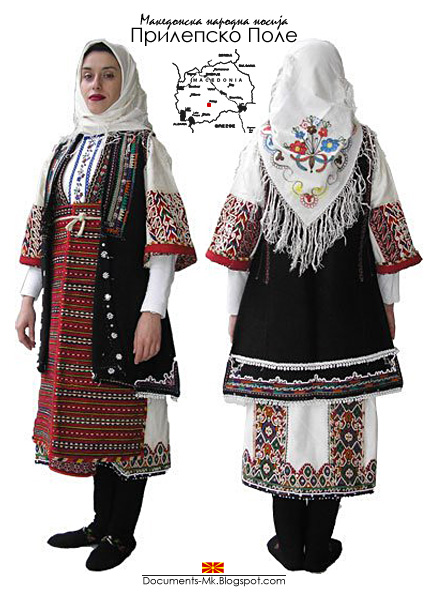 платно со везени украси, џамадан од црна клашна, појас ткаен од темно црвена волна, како и ресачка - горна облека од црна клашна, долга до колена. Специфичност на носијата од овој регион е употребата на скутина - унечка, како составен дел на машката носија.
 Apron "bofcha" Bitola, Macedonia - 1899-1900s. Wool fabric, bullion, copper:

 Logo of the Mobile Special Task Police Force of Republic of Macedonia against criminal.
 Coat of Arms of municipality of Stip, Republic of Macedonia
 Весник "Порой" 2 Август, 1908 година


 Македонска женска народна носија (Мијаци) - Крушево, Република Македонија.
 Logo of Customs of Macedonia
 Извадок од весникот Македонскiй Голосъ (Македонски Глас) издаван од македонскита колонја во Петроград. 8 Јуни 1915 ?
 Coat of Arms of municipality Prilep, Republic of Macedonia
 Logo of the Macedonian Olympic Comittee
 Coat of Arms of municipality Bitola, Republic of Macedonia
 Logo of the Army of Republic of Macedonia